Showing posts with label metabolism. Show all posts

Wednesday, July 13, 2011

To snack or not to snack...

There is a bit of a conundrum that is faced when trying to lose weight. Actually there are a few. But I am just going to tackle one for today: Snacking.

Some people see it as their downfall, the reason that they are overweight. "I can't stop snacking! I feel like I eat all day."

Other people swear by it for weight loss. "I eat 6 times a day and have lost 10 lbs this month!"

So which is it? 

Research and "belt science" would indicate that eating too much causes us to gain weight. At the same time research shows that those who eat 4-6 meals per day actually reduce more body fat than those who eat 1-2 times per day.

The truth? Eating frequently (every 2-3 hours) helps to speed up your metabolism, BUT....
Belly fat juice.

If your snacks are Tootsie Rolls, Doritos, M&M's and Pepsi (that includes diet too!) I will personally GUARANTEE that you will GAIN weight when you snack.
But if your snacks are carrots, cottage cheese, apples, yogurt, blueberries, almonds, pistachios or iced tea, then I will personally GUARANTEE that you will LOSE weight when you snack!

Eating frequently has been shown to alter your metabolism. If you eat more, you're metabolism will rise following your snack. However, if you eat sugary stuff your metabolism will not rise as much as when you have a high protein-high fiber snack such as apples and yogurt, or carrots and cottage cheese. 

Fruits and vegetables will ALWAYS be a better choice than chips, candy and soda. Chips and candy have almost ZERO nutritional value and as a result are energy sapping slugs that only send your insulin levels through the roof. And when insulin is constantly high, it stores excess energy as FAT. 

Protein on the other hand has a much slower digestion, requires more energy to breakdown and when it is broken down can be used for repairing muscles, organs, bone as well as providing energy. And it increases your metabolism for up to 30%. And a fast metabolism is the key to getting rid of stubborn belly fat.

Belly Fat Fighters
So how to sum this up and make it practical?

Snacks like cottage cheese, yogurt, 1 piece of fruit, baby carrots, broccoli sprouts, or a small handful of almonds or pistachios are the BEST foods for losing belly fat. Eat snacks in between your main meals and a small one before bed and your metabolism will begin to speed up and you'll start to see that spare tire slowly begin to deflate!

Wednesday, June 15, 2011

How much should I be eating?

Confused about how much you should be eating?
So since i've been working out more, and doing more throughout the day, I haven't been eating as much and I can feel that it has had a pretty astounding effect on me. But not the way you would think.

Most diets tell us to eat less. But what they fail to do is to tell us HOW MUCH less. Should we go on a diet of only 1200 calories or should it be a 2000 calorie diet? Should we even be eating fewer calories at all? What if we just need to rearrange the type and time of our calorie intake as it is right now?

Let me give you a quick example. I just started working with a new athlete. She's not overweight, probably hovering around 16% body fat and being a college athlete, one would assume is in pretty good shape. So as a part of the program she is on, I told her to complete a few days of a food record so that I could see what she was eating.

What I got back was not what I had hoped, but nonetheless not shocking. She's eating good food: lots of fruit, yogurt, chicken, beans, vegetables, wild rice, etc. But she's only getting around 1300 calories. Based on her age, height, lean body mass, and workout schedule, she needs AT LEAST 2200 on non-workout days and 2700 on days she works out.

And unfortunately, this calorie deficit is not helping her workouts either. Poor performance, excessive fatigue and even stagnation of weight loss is usually a result of not eating enough. Think about what happens when a person has a calorie deficit through decreasing food intake. When they lose weight, they have to cut calories more. When they lose more weight, they have to cut calories again. The question begs to be answered: when do you stop cutting calories?

My solution is that you have to feed your muscle, feed your exercise and feed your body if you want it to burn fat and RAISE your metabolism.

You like to eat right? Who doesn't. Well if you eat the RIGHT foods at the RIGHT time WITH resistance training, you'll get there. The biggest hurdle is finding the plan. This is where support from somebody trained in designing nutrition programs comes in. If you can dial in the plan, you can dial down the fat.

Books are often quite helpful too, because diet books have a diet spreadsheet type of page in them for you to print and follow. However, the downfall is that these aren't tailored to your specific needs. So use guidelines instead of following a generic diet to the letter. Here are 3 things that will get you on the right path:
  1. Eat breakfast. Only about 25% of your daily energy use comes from exercise. That other 75% comes from A) your resting metabolism, B) your daily chores and work C) eating. So to lose fat you gotta get these 3 calorie burners fired up. Breakfast is the first step.
  2. Eat more often. Each time you eat, your metabolism increases because it takes energy to break down food and convert it. So the more frequently you eat, the more you hit the gas pedal on your metabolism. So put the pedal to the metal and start eating 5-6 times per day!
  3. Eat more protein. Protein revs metabolism much higher than carbohydrates and fats combined. Plus protein can be used for energy and it leaves you feeling full longer after you eat! So have meat, dairy or eggs with each meal!
So don't wait for the perfect diet book. It's not out there. But by following steadfast rules that are shown to work, you can lose fat and maintain muscle!

Monday, December 27, 2010

100th Post!! - 5 Habits to develop for the New Year...

Well, Christmas day has come and gone. Which means that Christmas parties are gone and....New Year's parties are just days away.

But even more irrelevant, this is my 100th post on the blog!! Hopefully you're finding the information in each blog post useful, relevant and interesting! If not, just go ahead and send me an email or leave a comment with your suggestions!

Onward and upward to 2011!!

Being that between 42-45% of Americans make New Year's Resolutions but only 8% of resolutions are maintained, I wanted to give you guys 5 Healthy Habits to develop for 2011.

So here are 5 Resolutions that are easy to keep and help shred fat:
1. Eat Breakfast. Breakfast is the most important meal of the day for a variety of reasons. The first being that it stimulates your metabolism that has slowed considerably over night. Secondly it stimulates peristalsis which is a process that moves food through your digestive system, helping to maintain a healthy digestive system! A healthy breakfast is also incredibly easy to make!! Try some "Coach's Oats" with chopped apple, walnuts, a teaspoon of brown sugar and a cup of green tea!

2. Start eating 1/4 of  mixed nuts per day. Although these guys are high in fat, the fats they are highest in are the good, artery cleaning unsaturated fats. Just stay away from the flavored and honey roasted nuts. Stick with raw almonds, walnuts and cashews. When nuts are roasted, the fats change chemically and many are unusable by the body when they are heated. Mixed nuts are also a high protein, low carb snack that will keep your metabolism up and your insulin levels low and stable, keeping you in the optimal belly fat burning "zone."
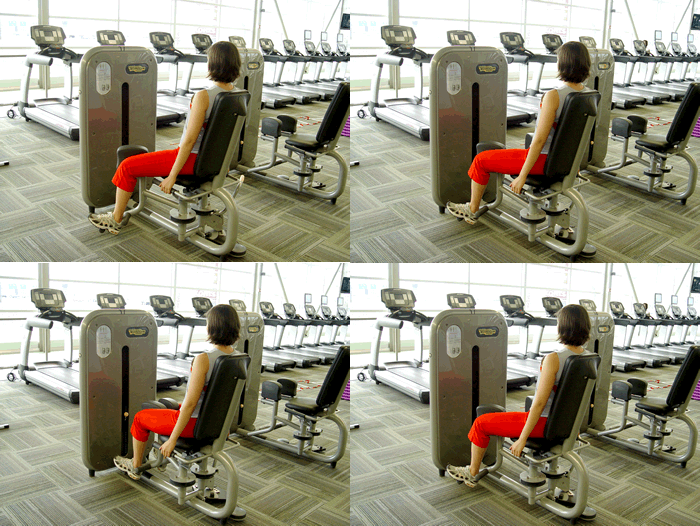
Seated Adduction Machine

3. Don't just buy a gym membership, sign up for class. Gym memberships are just that: a membership. It's not a workout, it's not activity. In fact, its like purchasing an anatomy book and then saying you're going to become a doctor. You have to have somebody teaching you how to USE what is available to you. Most people purchase a gym membership, walk in, hit the treadmill for 15-20 minutes and then look around for something that looks like it works their "trouble" spots, such as the seated adduction machine that wastes tons of time and only serves to make those muscles stronger, not to lose fat from that area. 

A class will help you stay focused, will be progressive and will open your mind as to exercises you can do on your own when the time comes. Plus, with classes all you really have to do is show up and put forth some effort. No thinking, wandering or guessing as to what to do next. Just show up and follow the instructor. Plus there is a set schedule so if you miss it, it's like missing any other appointment. I personally recommend our Hi-5 FitCamp. But I bet you already knew that!

4. Buy a book on nutrition and start learning. It's difficult to follow rules when you don't understand why the rules are there. By purchasing a quality nutrition book, you'll begin to understand why you need to eat so frequently, why your body NEEDS fat, why Low-Fat foods can actually MAKE YOU FAT, and why protein is so important in losing weight. I recommend The Metabolism Advantage by Dr. John Berardi. Great book, quite inexpensive and an easy read.
 
5. Look back at last year. Those who forget history are doomed to repeat it. If you aren't satisfied with the way you looked and felt last year, then you need to know why you looked and felt that way. Look back at pictures of yourself and become determined to make a change. Take a picture on January 1st and then take one on the first day of every month and make sure that you are making progress. If you aren't changing, then something in your life isn't working. Most often its a result of inconsistent eating, poor food choices, and not enough movement. In which case you need to look at Number 4 again.

Look, 2011 doesn't have to be the year your resolutions drop flat. Set goals, write them down and achieve them. After all, we aren't getting any younger!

    Monday, December 6, 2010

    Holiday woes...

    This is a really quick blog post but it needs to be repeated. 

    Christmas and Thanksgiving are notorious for being the worst times to try and lose weight. Why? Because everything is centered around food. More specifically high carbohydrate foods loaded with sugar.

    Cute little mice like this will reign havoc on your belly.
    What do high carb foods do to us? Well, even if we are following a calorie restricted diet where calories consumed are fewer than calories burned during the day, high sugar/simple carbohydrate foods still have a field day with our INSULIN levels and as a result our body will STORE THE SUGAR AS FAT.

    And the funny thing is that everybody wants the low fat, low calorie option that is usually LOADED with sugar or simple carbs. Did I mention what sugar/simple carbohydrates do to us? 

    Our bodies need protein. Protein slows the digestion process, has a MUCH more stable insulin release and increases our metabolism more than ANY carbohydrate can. Protein is a WIN-WIN-WIN situation. Yet foods that are high in protein such as turkey, chicken, steak, fish and eggs are demonized as being "high fat" foods. 

    Here's a quick little secret for you: IT IS NOT TOO MUCH FAT THAT IS MAKING OUR COUNTRY FAT. It is the combination of fat eaten with sugar/simple carbohydrates that is making our country fat. We need to eat more protein, more fat (in the form of unsaturated fats), and fewer simple carbohydrates. If this simple model is paired with exercise, then weight loss shouldn't be a problem.

    So here are 5 rules to follow this Christmas season to get you on the fat loss wagon by eating right, rather than simply eating less.
    1. Eat more protein. At that Christmas dinner, feel free to have some ham, turkey, chicken, fish or eggs.
    2. Eat more fat. Almonds, cashews, walnuts, pecans, and peanuts are all good for you. Just don't get the candied variety. Focus on eating raw nuts 
    3. GET THE CANDY AWAY. After talking about the havoc that sugar can play, do you really want to "test" yourself and see how strong your will is by leaving candy around the house or office? Get it out of sight. Out of sight, out of mind. Plus if its not there you can't eat it.
    4. Drink only non-calorie drinks. Holidays are notorious for having high calorie drinks around. Most parties will have soda, beer, eggnog, and some other sugary drink. Stick with hot/iced tea, water, or coffee. Although with coffee, you'll need to have a little protein with it. I recommend this green tea. It's tasty, not overwhelming and is free of caffeine and calories.
    5. Eat before the party. If you know you're going to a Christmas party where there is sure to be sweets, candies and other bad foods, have a good healthy meal before the party. Don't gamble on there being healthy food there for you to stick to your eating plan. If you believe this, you're fooling yourself.
    6. Bonus tip---Motivate yourself with Exercise. If you are going to a party in the evening, go through a quick 15-20 minute circuit at home that challenges you. By doing this you'll be motivated to maintain your eating habits because you don't want to waste the 20 minute circuit you just did. Why take a step forward only to take 3 steps back at the party? 
    A basic body weight circuit such as this takes only 15 minutes and can burn up to 150 calories. Just don't use the exercise to justify your bad eating habits at the party. Here is a link to a quick 15 minute circuit that sill chew through calories (pardon the pun).


    Remember, you only exercise 4 hours per week. Exercise alone will not create the change you are looking for. Nutrition is a must.

    Wednesday, June 9, 2010

    The dreaded.... PLATEAU!!

    Everybody hits a plateau in their fitness journey. Whether it is a weight loss plateau, a strength plateau or simply the program becoming stagnant, plateau's are almost inevitable. But there is a way to break through...

    A plateau will occur when the body has reached a point of stability, where it has adapted to the changes that you have imposed on it. For some, this means your body has adapted to the weight you have been using in your training program. This generally occurs after 3-6 weeks. Some people adapt sooner, others take longer to adapt.

    For others a plateau will occur when you have been on a restricted calorie diet for a given period of time. You've been doing well on a restricted eating plan, you've consistently had a negative calorie balance but now it seems you are at a calorie equilibrium. Let me attempt to quickly explain how this has happened.

    Your body's metabolism is the rate at which it uses available energy. Your metabolism can be changed by a variety of factors but they are primarily hormonal and the change is often regulated by how you are treating your body. During a negative calorie balance (taking in fewer calories than you are using) your metabolism will slow down due to the fact that there is a decrease in energy. It's simply a cause and effect situation.

    What most people do once they reach a point of calorie equilibrium, or plateau, is they simply decrease their calories even further. This may work. However, you will eventually reach a point where you are not taking in many calories at all. Many people reach the point to where they aren't bringing in enough calories to get through the day. At this point, your muscle breaks down, your bones break down and you feel sluggish and tired.

    But there is HOPE...plateau's can be stopped dead in their tracks with on thing...CHANGE. No not that political type of change! I'm talking about changing your eating habits or changing your exercise program. This is why we change up our Hi-5 FitCamp every 4 weeks. Because it is just enough time to allow our body to adapt to the stress imposed on it, but not so long that we get stagnant and plateau. Keep moving UPWARD and ONWARD toward the goal!

    Your eating habits need change too. And here are 5 ways you can change your eating habits to avoid the plateau.
    1. Have a scheduled cheat day. Don't go overboard eating everything in sight. But eat the foods you want and eat until you are content, not stuffed. If you want the steak...EAT THE STEAK! If you want dessert, EAT DESSERT! Just don't make it an everyday occurrence and be sure to eat well the other 6 days of the week!
    2. Involve more fruits and veggies into your diet. Fruits and veggies are known to speed up metabolism, and there are some that have a dramatic effect on metabolism!!
    3. Change your macronutrient ratio. Fats, Carbs and Proteins are macronutrients. Take a look at your plate and see what percentage each nutrient comprises. Most people are around 60:20:20 (Carb:Fat:Protein). So change it up to where you have a 40:30:30 profile for 2 weeks. Eat more protein, fewer carbs and more healthy fats. Set up a Caloriecount.com profile and it will do this for you when you use the food journal!!
    4. Switch to full fat dairy for breakfast foods! Research from the University of Alabama shows that they type of food you eat in the morning dictates what your primary fuel source will be for the day. So if you have a higher fat breakfast, your body will use more fat during the day!
    5. Split up your meals. If you are eating 3-4 meals per day, split them up to 6-7. This way you are increasing your Thermic Effect of Feeding (TEF). TEF is the calorice cost of digesting and absorbing food. Eat more frequently and you use this metabolic booster to your advantage!
    I do not recommend attempting to implement all of these changes at once. Instead, simply make one change per week. This way you will be able to see which change has the greatest effect for you. Plus implementing one change per week ensures that you will prolong the dreaded plateau!!

      Tuesday, May 18, 2010

      Burn Fat with these 4 stead fast rules...

      Fat burning nutrition can be a tricky thing.The average person thinks, "If I want to lose fat, why am I still eating?" 

      It's as if the idea that not eating will cause your body to lose fat, which isn't completely true. Yes, if you go long enough without eating, you'll certainly lose fat. But to go along with it will muscle and bone.

      When trying to lose fat, the LAST thing you want to do is to stop eating. Instead here are 4 things you need to do to start burning fat at rest.
      1. Know how much you are eating. Go to a website such as www.caloriecount.com and start tracking how much you are eating. If you don't know how much you are currently eating, you won't stand a chance in your battle against the bulge!
      2. Eat breakfast. Breakfast IS the most important meal of the day for a variety of reasons. But here we will focus on its ability to give your metabolism a good jump start! Think about what sleep is: It's 6-9 hours of not eating. When you go long periods without eating, your metabolism slows down due to an increase in sympathetic hormones. Eating breakfast fires up your metabolism.
      3. Eat lots of fruit. At this point I don't really care if your fruit is fresh, frozen or dried. Just make sure you get 5 servings of fruit a day. Some fruits that have been suggested to have "fat burning" potential are grapefruit, blueberries, apples, bananas, strawberries and cantaloupes.
      4. Eat protein with each meal. Protein has a variety of factors that help to use more fat at rest. First off, it takes a long time to digest and absorb. Remember that every time you eat a food, your metabolism increases during the digestion and absorption of food. Protein has the highest metabolic boost during digestion. In addition protein helps to keep bones and muscles rebuilt. Therefore, protein from dairy, meat, beans, nuts, or fish should be included with each meal, even your snacks.
      5. And speaking of Snacks, here is a bonus tip: Eat frequently. Take your calories and break them down into 5 meals. By eating fruits and protein with each meal you A)keep your metabolism up longer, B) keep your body using more fat to fuel the digesting process and C) you are able to keep your energy levels stabilized that reduce the harmful effects of going into a hungry period followed by a binging period.
      So there are 4 tips plus a BONUS tip to get you started. But remember, it all starts with knowing how much you are eating. If you aren't willing to track what you are eating, then no recommendations are really going to have much of an effect.

      Have a great week and be sure to try the Recovery Week Challenge!!

      Friday, March 5, 2010

      Metabolism Matters Part 3: Eat to Lose Weight

      Yesterday we talked about the importance of your RMR, why it is so crucial to your fat loss success and how you can ramp it up.

      Today we are going to talk about the food you eat and how it either slows your metabolism down or speeds it up. So hopefully you are eating the right ones!!

      The Thermic Effect of Food (TEF) is the increase in metabolic rate due to the digestion and absorption of food. As I stated in the first blog post, this can account for anywhere from 10-20% of your daily caloric use, or calorie burn.

      There have been some FOL's (flat out lies) floating around regarding the manipulation of TEF. The most outrageous is that of "negative calorie foods." These are foods that supposedly require more energy from your body to break down than they hold. An example of this would be a banana that has 120 calories but requires 150 calories from your body to metabolize, resulting in a -30 calorie deficit.

      Again, this is a FOL. If this were possible you would have heard about it a long time ago, there would most likely be a banana shortage, and every banana would sell for $10.

      Now there are foods that ramp up your metabolism more than others. Foods that are high in protein (meat, dairy, nuts) can increase your metabolic rate by up to 30%. Complex carbohydrates such as whole grain breads, fruits, vegetables and lentils can increase your metabolism by 15%. Fat on the other hand only increases your metabolic rate by about 3%, certainly not worth the enjoyment you'll get from a piece of cheesecake.

      Strategies for eating to increase your TEF is to eat protein with EVERY meal. This again will slow down digestion and increase your TEF significantly. The other thing is to eat complex carbohydrates. Paired with protein, you're looking at a substantial metabolic rise during metabolization of those foods.

      Just as importantly, avoid white breads and simple sugars as they breakdown very quickly, have a high insulin response (which opens cells for energy deposit; Any energy not used quickly is stored as fat), and don't do much to increase your metabolic rate.

      The other thing to consider is that every time you eat, your metabolism cranks up!! Therfore the more you frequently you eat, the HIGHER YOUR METABOLISM!! A few years ago there was a study that was published compared two groups of people. Both ate the same number of calories and had the same macronutrient profiles (CHO:PRO:FAT ratio's). One group ate twice a day, the other group ate 5 times per day. The group that ate twice per day had an INCREASE IN BODY FAT!! The group that ate 5 times per day actually lost weight. Keep in mind these groups were eating THE SAME NUMBER OF CALORIES!!

      Take home message: Eat frequently, eat breakfast, eat protein with every meal!

      So now you know what TEF is and how to manipulate it for fat loss. So take this information and RUN WITH IT!! Prepare your meals so that even your snacks have protein coming in with them (yogurt, cottage cheese, peanut butter, etc.)

      Stay tuned tomorrow for our last installment of Metabolism Matters, when we talk about what exercise can do for your metabolism!!

      Wednesday, March 3, 2010

      Metabolism Matters - Part 2: Resting Metabolic Rate

      As we discussed yesterday, your RMR is the amount of energy your body requires for you to sit and do nothing all day. This accounts for between 60-70% of your caloric expenditure for the day, depending on how frequently you eat and how frequently/intensely you exercise.

      One of the real secrets to fat-loss is how to increase this rate to burn the most calories in your day.

      A quick sidebar on fat metabolism though. Your body burns the greatest PERCENTAGE of fat at rest and low intensity movements. Your body uses fat for up to 50% of its energy needs. Why only at a low level?

      Fat requires a large amount of energy to breakdown (9 calories). So it takes longer. When not much is going on in your body, it can take the time to breakdown fat. But when you are working hard, your body needs energy much quicker. This is why it will use carbohydrates. They only require (4 calories) to breakdown.

      Return from the sidebar.

      So resting metabolism is determined by your age (decreases as you age), your gender (men have faster metabolism's than women) and muscle mass. The third factor is the only one you can realistically alter.

      Muscle has a higher metabolism at rest than fat. It is what we call "metabolically active." Therefore, if you add 5 pounds of muscle to your frame you could expect your metabolism to increase and thus use more fat at rest to support the muscle!!

      However, if you were to lose weight from a calorie restricted diet only, you would lose an equal amount of muscle and fat. Why? Well as your body loses weight, it does not need as much muscle to haul that extra weight around. So since the demand is no longer there, the muscle will atrophy. This in turn decreases your metabolism. As a result to lose more weight, you have to cut back on your eating even FURTHER!!

      You can see how this turns into a vicious cycle.

      Take home point...to lose weight effectively and keep losing FAT, you have to be on some sort of a resistance training program. I am not advocating a body building program, but resistance training twice a week that places demand on the muscles greater than what it is accustomed to is a MUST!!

      If you aren't on a resistance training program, and would like to be on one, email me about our Hi-5 FitCamp!! or click on that link. This is one of the key parts to our weight loss strategy and it can be for you too!

      Email aaron@pairmarotta.com for more information.

      Stay tuned for Part 3: The Thermic Effect of Food and Your Belly.

      Tuesday, March 2, 2010

      Metabolism Matters: Part 1

      Your metabolism is the basis for fat loss. The faster your metabolism, and its components, the more calories and fat your use at rest. This is why we all look at younger people with disdain - they can eat whatever they want and it seems they just get skinnier!!

      But the truth is, you too can do things to speed up your metabolism!!

      There are 3 parts that make up your entire metabolism:
      1. Resting metabolic rate (RMR) (60-70%) - This is simply the energy required for your body to maintain homeostasis and keep all its systems working properly
      2. Thermic effect of food (TEF) (20-30%) - This is the energy required to chew, digest and absorb the food you eat. Certain foods stimulate this more than others. Fat increases your metabolic rate by only 3%, whereas protein increases your metabolic rate by up to 30%!!
      3. Thermic effect of exercise (20-30%) -This is the energy spent to fuel exercise. Unfortunately it is also the primary way people try to lose weight. Although it is a portion of your metabolism, however this really only counts your exercise while you are exercising.
      So what the primary goal of each of these should be is to ramp each of them up so that we are using each to its maximal fat-burning potential! this is just a brief over view, but for the next 3 days I will address how we can do just that- Improve your fat burning potential!!

      So stay tuned!